Heinz Knobloch
Using “feuilletons” to combat historical amnesia
Heinz Knobloch (1926–2003), born in Dresden, found in Berlin the center of his creative and professional life as a journalist and writer.
His journalistic work comprises more than 1,600 feature articles (feuilletons), which he wrote over a period of more than 40 years, initially for magazines. Through his column “Mit beiden Augen” (“With both eyes”)—published for 20 years in the Wochenpost— he is regarded as the last major representative of the “Kleine Form” (“short form”) of German-language newspaper feuilleton. Under the conditions in the GDR, he knew how to encourage his readers to “read between the lines” and used the leeway he had to address social grievances. At the same time, he saw himself as a chronicler of the societal developments of his time. Even after the fall of the Berlin Wall, he successfully continued his work.
He achieved his literary breakthrough with the book Herr Moses in Berlin (first published in 1979), which received attention both in the GDR and in West Germany. His vivid portraits of courageous personalities were meticulously researched and continue to offer readers stimulating inspiration today for walks or journeys to the places he described. A total of six commemorative plaques in Berlin, initiated by him, continue to still bear witness to his commitment and successful work of remembrance.
The exhibition provides an initial insight into the extensive literary estate of Heinz Knobloch, held by the Staatsbibliothek zu Berlin. The honorary curator is Helmut Mehnert, who is working on cataloguing the estate and manages the website www.heinz-knobloch.de.
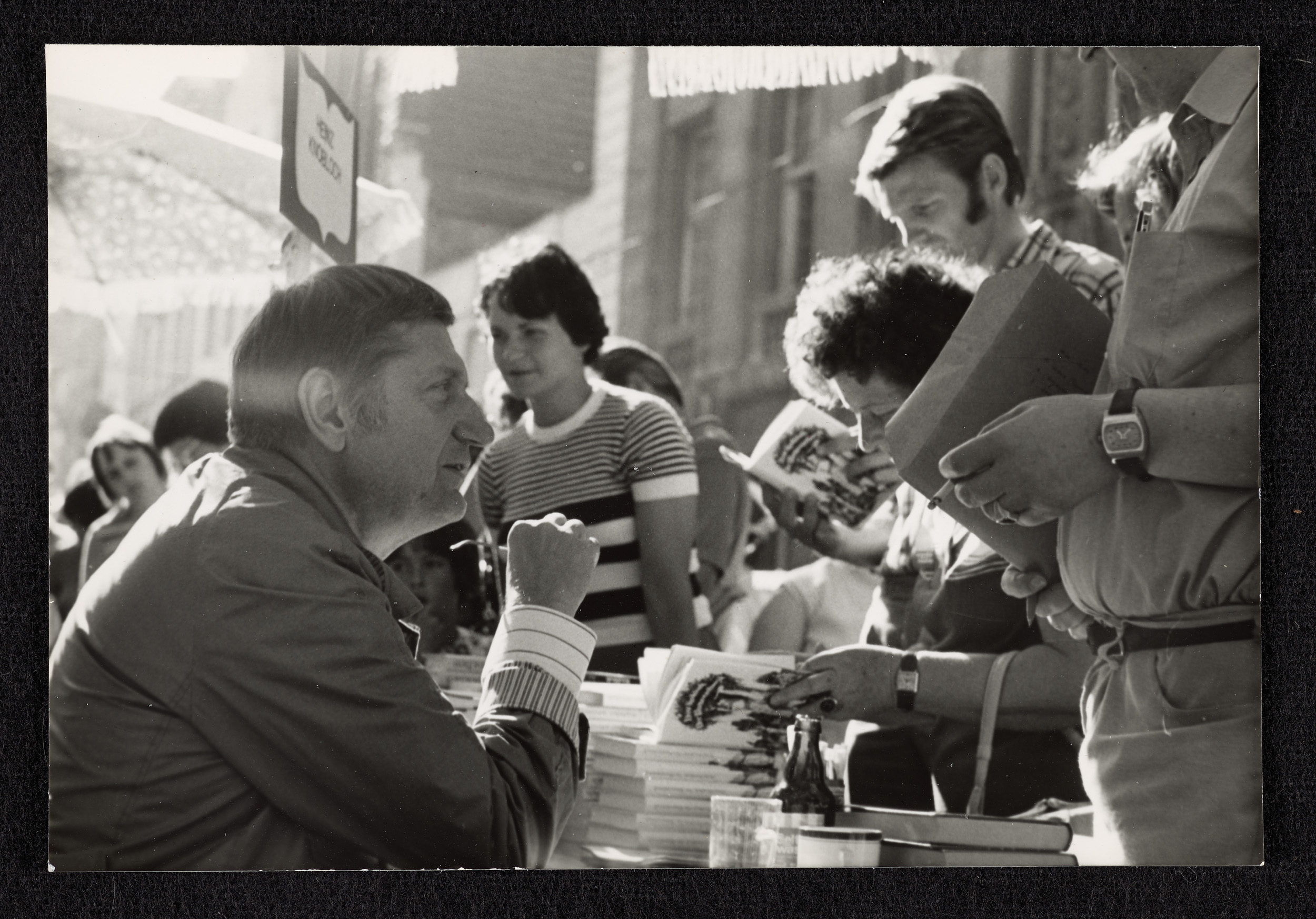
Image: Heinz Knobloch signing books at the XIV. Book fair in Rostock 1977, photographer unknown. © Stabi Berlin.